Hello, if you have any need, please feel free to consult us, this is my wechat: wx91due
MAT223H5S - Linear Algebra I - Winter 2025
Term Test 1 - Version A
1 1.1 (6 points) Consider the matrices below: for each one, determine if it is invertible or not.
Give a short explanation of your answer. Unsupported work will receive 0 points.
Hint: you should do this by computing the determinant of each matrix.
(a) 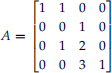
(b) 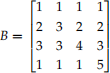
Hint: Apply row operations (remembering how they affect the determinant) to make this much easier.
1.2 (4 points) Compute the inverse of the matrix 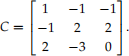
2 Consider the matrices  and
and 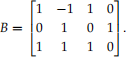
2.1 (4 points) Consider the products AB and BTA. Determine which one of these products exists, and
which does not. Compute the product that exists, and briefly explain why the other does not exist.
2.2 (3 points) Determine the rank of B.
2.3 (3 points) Solve the system  (determine the general solution, or show it is inconsistent.) l-1」

3 3.1 (6 points) Consider the following matrix, where a is an unknown real number:
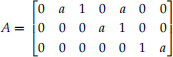
Determine the value(s), if any, of a such that the matrix A is in RREF. Do not row reduce the matrix.
3.2 (4 points)
 and
and 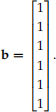
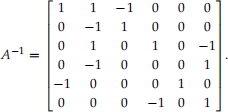
Use this to determine the (unique) solution x to the system Ax = b. No credit will be given for solutions that use row operations.

4 4.1 (5 points) Let A be the following matrix (where a is an unknown real number):

Give a detailed explanation of the fact that A is diagonalizable for a > 0, and that A is non-diagonalizable for a ≤ 0. Show all your steps.
Hint: be careful with the case a = 0.
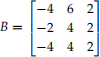
You may assume that the characteristic polynomial of B is CB(x) = (x - 2)2 (x + 2). Find an invertible matrix P and diagonal matrix D so that B = PDP-1.
You do not need to compute P-1.
Or, show that B is not diagaonlizable.
5 (2.5 points each = 10 points)
Determine if the statements below are true or false.
Make sure to justify your answers! You will receive no credit for simply selecting “true" or “false", or providing little explanation.
5.1 True or False: If an n × n matrix A is diagonalizable, then for any real number r, the matrix rA is also diagonalizable.
5.3 True or False: If A and B are n × n matrices, and Ax = 0 has k basic solutions while Bx = 0 has j basic solutions, then (A + B)x = 0 has k + j basic solutions.
5.4 True or False: Suppose A is an m × n matrix with m > n. If b ∈ Rm and Ax = b is consistent, then Ax = b has a unique solution.