Hello, if you have any need, please feel free to consult us, this is my wechat: wx91due
MATH 235 Online
Practice Test 2
June 2024
1. (12 points) For the following multiple choice questions, choose the correct answer. There is precisely one correct choice per question. Each correct answer is worth +1, each incorrect answer is worth →1/4, and there is no penalty for questions left blank. (No work needs to be shown for this problem.)
(1) The limit as (x, y) → (0, 0) does not exist for a function f(x, y). If f(r, ω) is the same function written in polar coordinates, the following may be possible:
(A) f(r, θ) = r2
(B) f(r, θ) = r cos θ
(C) f(r, θ) = (1/r) cos θ
(D) All of (A)–(C) may be possible
(E) None of (A)–(D)
(2) Suppose lim(x,y)→(0,0) 2f(x, y) = L for a function f(x, y), where L is a constant. The following must be true:
(A) lim(x,y)→(0,0) f(x, y)=1
(B) lim(x,y)→(0,0) f(x, y) = L/2
(C) lim(x,y)→(0,0) f(x, y) does not exist
(D) lim(x,y)→(0,0) f(x, y)=2L
(E) Not enough information given to decide
(3) Suppose h1(x, y) < f(x, y) < h2(x, y) for all (x, y) in the domain of f. The following must be true at a point (a, b):
(A) f(a, b) = h1(a, b) = h2(a, b)
(B) lim(x,y)→(a,b) f(x, y) exists
(C) lim(x,y)→(a,b) f(x, y) = lim(x,y)→(a,b) h1(x, y)
(D) All of (A)–(C)
(E) None of (A)–(D).
(4) γ1(t) and γ2(t) are two parametrizations of the same curve C in R3, each with nonzero speed. If γ1(t1) = γ2(t2) = p, the following must be true:
(A) γ'1 (t1) = γ'2 (t2)
(B) γ'1 (t1) = -γ'2 (t2)
(C) γ'1 (t1) = cγ'2 (t2) for some nonzero constant c
(D) Either (A) or (B) (c = ±1 in (C))
(E) None of (A)–(D)
(5) γ1(t) and γ2(t) are two parametrizations of the same curve C in R3, each with nonzero speed and traveling in the same direction. Suppose γ1(t1) = γ2(t2) = p and L is the tangent line to C at p. For -∞ < t < ∞, L can be parametrized:
(A) p + tγ1(t1)
(B) p + tγ2(t2)
(C) p + t(γ'1(t1) + γ'2(t2))
(D) Both (A) and (B)
(E) None of (A)–(D)
(6) γ1(t) and γ2(t) are parametrizations of the curves C1, C2 respectively. If C1 and C2 intersect at a point p, then it must be true that:
(A) γ1(t1) = γ2(t2) for a pair of times t1 ≠ t2
(B) γ1(t1) = γ2(t1) at a time t1
(C) There are no times t1, t2 such that γ1(t1) = γ1(t2)
(D) Either (A) or (B) must be true
(E) There’s not enough information to determine which of (A)–(D) holds.
(7) Let f(r, θ) denote a function f(x, y) written in polar coordinates. If limr→0 f(r, θ) = sin θ, then lim(x,y)→(0,0) f(x, y) is:
(A) 1
(B) -1
(C) 0
(D) One of (A), (B), or (C)
(E) Does not exist
(8) A function f(x, y) satisfies lim(x,y)→(1,0) f(x, y) = f(1, 0). It must be true that:
(A) f is continuous at (1, 0) (B) ϑxf exists at (1, 0)
(C) ϑyf exists at (1, 0)
(D) (A) and (B)
(E) (A) – (C) are all true.
(9) A function f(t, x, y) solves ϑtf + ϑxf - Δf = 0 at a point p = (t, x, y). The following must be true at p for g(t, x, y) = tf(t, x, y):
(A) ϑtg + ϑxg - Δg = 0
(B) ϑtg + ϑxf - Δf = 0 (C) ϑtf + ϑxg - Δg = 0
(D) ϑtg + ϑxg - Δg = +f
(E) None of (A)–(D)
(10) Consider the curve γ(t) = (cos(t), -te3t-5, 14 log t), 0 < t < ∞. Then γ is confined to the following region:
(A) {x > 0}
(B) {y < 0}
(C) {z > 0}
(D) Two of (A)–(C)
(E) None of (A)–(D)
(11) Consider the curve γ(t)=(x(t), e-t - t, z(t)), -∞ < t < ∞. It must be true that:
(A) γ is not a line
(B) γ cannot lie on a sphere
(C) γ can lie on {y = x2 + z2}
(D) All of (A)–(C)
(E) Not enough information given to decide
(12) Consider the curve γ(t)=(x(t), y(t), z(t)), 0 < t < ∞ parametrizing all or a part of the intersection of {z = x2 + y2} with a plane. Then it is impossible that:
(A) x(t) = sin(t) and y(t) = cos(t) (B) x(t) = c for a constant c (C) x(t) = y(t)
(D) x(t) = t and z(t) = ln t
(E) (B) and (D)
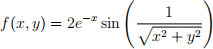
2. (9 points) For each of the following functions f(x, y), determine whether the limit as (x, y) → (0, 0) exists. If it does, calculate the limit. If it does not, clearly show why.
(a)
(b)
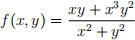
(c)
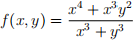
3. (7 points) Consider the surface S given by {x2 = y2 + z2}.
(a) Give a parametrization of the intersection of S with the plane {2x → y +1=0}.
(b) For y defined implicitly by the equation for S, use implicit di”erentiation to find ϑzy and ϑxy at (2, √2, √2).
4. (6 points) Find all points, if any, on the graph of f(x, y)=5→x2 →2y2 at which the tangent plane at that point is parallel to {x + 4y + z = 1}.
5. (12 points) Consider the function

(a) Find ϑxf and ϑyf at (0, 0)
(b) Find ϑxf and ϑyf at (x, y) ≠ (0, 0)
(c) Is f di”erentiable at (0, 0)? Justify.
(d) Find ϑxϑyf at (0, 0) if it exists.