Hello, if you have any need, please feel free to consult us, this is my wechat: wx91due
PY7001
Fuels, Combustion, and Emissions
December 2024
SECTION A (Fossil Fuels, Combustion, Engines and Emissions)
Q 1. Answer all Parts
Sketch a diagram to describe the classical particulate-NOX trade off as it pertains to conventional liquid transportation fuels and combustion devices.
Address the following aspects with care:
(a) Label each axis (including any units of measure) and assign quantitatively accurate scales to each axis, being careful to define the minimum and maximum ranges. [1 mark]
(b) Define regions of the diagram where one could reasonably expect soot and NOX to form.
Provide evidenced scientific reasoning (chemical structure, chemical reaction mechanism, concentration, phase change, device operation characteristics, thermochemistry, reaction kinetics, combustion science theory) to explain your decisions. [2 marks]
(c) On to this diagram, sketch to relative quantitative accuracy the behaviour you would expect for each of the fuels:
(i) toluene.
(ii) n-dodecane.
(iii) Synthetic aviation fuel hydrogenated esters and fatty acids (HEFA-SPK).
(iv) Conventional jet aviation fuel (Jet A-1)
Provide evidenced scientific reasoning (chemical structure, chemical reaction mechanism, concentration, phase change, device operation characteristics, thermochemistry, reaction kinetics, combustion science theory) to explain your decisions.
Hint: for the purposes of this question assume the adiabatic flame temperature is the reaction temperature at each condition.
Q2. Answer all Parts
(a) Showing all of your workings and referencing all of your data sources, calculate the adiabatic flame temperature for each of the fuels below at a fuel air equivalence ratio of 1.0.
(i) Methane [2 marks]
(ii) Ethanol [2 marks]
(iii) n-decane/iso-octane/toluene 0.42/0.33/0.25 mole fraction [4 marks]
(b) Do you expect your calculations to be closely equivalent to experimental
measurement of the temperature of these flames?
Justify your answer with combustion science. [2 marks]
Q3. Answer all Parts
(a)
(i) Describe the formation mechanism of soot by providing an essential discussion under each of the following topics:
(a) The generally accepted global chemical reaction mechanism with
descriptions of at least two detailed reaction pathways. [1 mark]
(b) The significance of molecular thermodynamics
(a sketch may be helpful) [1 mark]
(b) The diagram below describes the dynamic combustion (explosion) limits of a well- known fuel.
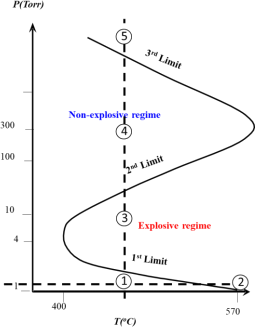
Quoting elementary chemical reaction processes, describe what combination of reactions and/or other fundamental processes result it the presence or absence of explosion moving along the isobaric boundary from positions:
1→2 [1 mark]
and along the isothermal boundary from positions:
1→3 [1 mark]
3→4 [1 mark]
4→5 [1 mark]
Your answers must also explain why these processes produce the observed effect.
(c) Hypothesis as to why the reaction: CO + ȮH = CO2 + Ḣ may be important to hydrocarbon combustion. [4 mark]