Hello, if you have any need, please feel free to consult us, this is my wechat: wx91due
Vectors and Optimization Exercises
1. Vectors. Let vector a = (1, 2) and vector b = (1, 0). Plot these vectors on (x1 , x2 ) space. Calculate vectors c = a + b and d = b — a. Plot these vectors on the same diagram. Are any of the vectors, a, b, c, d orthogonal to each other? Calculate the scalar products of the corresponding vectors to prove your answer.
2. Vectors. Let vector a = (1, 2, 3) and vector b = (2, —1, 3). Calculate vectors c = a + b, and d = a — b and scalar products of vectors
a . b
a . c
b . c
3. Vectors and matrices. Consider vector a = (1, —1) and matrix  . Note that a' =
  . This operation is called transpose, the notation is a' , (or aT ) turns a string vector into the column vector and a column vector into the string vector. Calculate a . B (this should be a vector of size 1 × 2) and B . a' (this should be a vector of size 2 × 1). Calculate scalar products a . a' (this should be a number) and a' . a (this should be a 2 × 2 matrix).
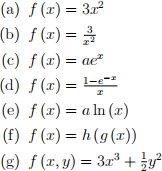
4. Differentiate the following functions
5. Implicit functions 1. Take the budget equation
p1 x1 + p2 x2 = w
Find the slope of the implicit function x1 (x2). Show your work.
6. Optimization 1. A consumer seeks to maximise her utility by choosing how much of commodities A and B to consume. Let xA and xB denote the quantities demanded, and (pA , pB ) the prices. Our consumer has utility
u(xA , xB ) = ln(1 + xA ) + ln(1 + xB ),
and she is subject to the budget constraint
xApA + xBpB = M
(a) Find the optimal bundle (xA , xB ).
(b) How does the level of utility u(xA , xB ) change when the consumerís income
M changes? Relate this to the value of the Lagrange multiplier.
7. Optimization 2. You need to enclose a rectangular field with a fence. You have 100 meters of fencing material. Determine the dimensions of the field that will enclose the largest area. Set this up as a constrained optimization problem and approach this with Lagrangean. Hints: use all the information to determine the objective function and the constraint. It may help to draw. Recall: What is the area of a rectangle? Call the short side x and the long one y. What is the perimeter of such rectangle?
8. Optimization with inequality constraints. Find
max f (x, y) = xy
s.to. x + y2 ≤ 2
x ≥ 0, y ≥ 0
Approach this formally via Lagrangean. Write all the Karush-Kuhn-Tucker condi- tions. Argue that the non-negativity constraints will not bind and that the x+y2 ≤ 2 constraint will hold as equality. Solve the resulting system of equations.