Hello, if you have any need, please feel free to consult us, this is my wechat: wx91due
ELEC/XJEL3430
Digital Communications
PROBLEM SET 4
Recommended Readings:
Baseband Modulation: Glover and Grant, Sec. 6.4; Sklar, Sec. 2.8
Performance Analysis, matched-filter receiver: G&G Secs. 6.2, 8.3; Sklar Secs. 3.1-3.2
Problem 1: Baseband Binary Communication
Consider a binary communication system with bit rate 1/T in which equi-probable databits 0 and 1 are, respectively, encoded by the following pulse shapes:
s0 (t) = A, 0 < t < 2T / 3
s1(t) = A, T / 3 < t < T , and zero otherwise.
Suppose that the communication channel is an AWGN one with two-sided spectral density N0 / 2 with no other distortions.
a) Plot s0 (t) and s 1 (t) .
b) What is the bandwidth efficiency of this modulation technique?
c) Find the energy associated with the above pulse shapes. What is the average energy per bit, Eb ?
d) Find the inner product between s0 (t) and s 1 (t) .
e) Draw s0 (t) and s 1 (t) as vectors in a plane. Specify the length of each vector as well as the angle between the two vectors.
f) Obtain and draw the correlation receiver for this signaling.
g) Find the bit error rate for this system and write it in terms of Eb / N0 .
Problem 2: Baseband Binary Communication
Consider a binary communications system with bit rate 1/T = 1 Mbps, in which equi-probable data bits 0 and 1 are, respectively, encoded by the following pulse shapes:
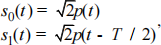
 and zero elsewhere. We use an AWGN channel with two-sided spectral density N0 / 2 to transmit the data.
(a) Plot s0(t) and s1(t) . (Specify the numerical values for all relevant time parameters and amplitudes.)
(b) What is the bandwidth efficiency of this modulation technique?
(c) Find the energy associated with the above pulse shapes. What is the average energy per bit, Eb ?
(d) Find the inner product between s0(t) and s1(t) .
(e) Draw s0(t) and s1(t) as vectors in a plane. Specify the length of each vector as well as the angle between the two vectors.
(f) Obtain and draw the optimal matched filter receiver for this signalling.
(g) Find the bit error rate for this system and write it in terms of Eb/ N0 .