Hello, if you have any need, please feel free to consult us, this is my wechat: wx91due
MGMT 464 Logistics: Concepts and Models – Spring 2025
Homework 4 – Vehicle routing & Warehouse decisions
Points are allocated to each question 30 points in total for the HW
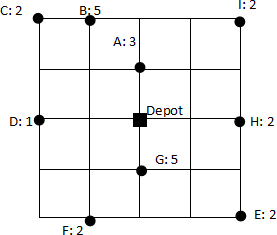
1. RepEx needs to pick up goods from customers A to I. The pickup sizes and the location of the customers are shown on a grid with 1 mile unit length. Each RepEx truck can only carry 10 units of goods. (Hint: Use the Pythagorean theorem to find the distances)
a) Develop routing using the “Sweep” method (use a counterclockwise sweep starting from customer H) and calculate the total distance travelled. (2 points)
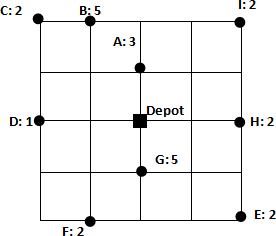
b) Does the routing you found in a) violate any of the principles for good routing? Can you find a better routing? What is the total distance travelled? (3 points)
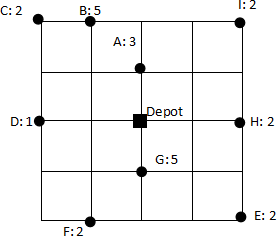
c) In the “Savings” method, assume the initial routing plan is to visit each customer in a separate route. Calculate savings for each couple of locations, change the route step by step adding the locations that have the highest saving first. Draw the final solution below. (5 points)
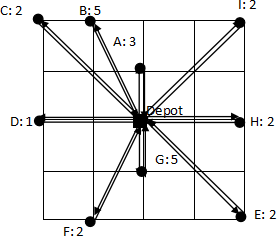
Solution
2. XYZ Electronics Corporation is evaluating its warehouse needs due to fluctuating space requirements throughout the year. The company manufactures replacement parts for home electronics, and space demands vary due to production cycles and seasonal sales. The company operates in a stable market with no expected growth or decline in the near future. Monthly sales (throughput) for a typical year are shown in the table below:
|
Month |
Throughput, Dollars |
|
Jan |
5,500,000 |
|
Feb |
4,200,000 |
|
Mar |
3,200,000 |
|
Apr |
2,500,000 |
|
May |
1,300,000 |
|
Jun |
500,000 |
|
Jul |
1,100,000 |
|
Aug |
2,300,000 |
|
Sep |
3,300,000 |
|
Oct |
3,800,000 |
|
Nov |
4,500,000 |
|
Dec |
5,000,000 |
The warehouse inventory turns at a rate of 2 times per month. Merchandise valued at $1,000 occupies 100 cubic feet of space and can be stacked 10 ft. high. The product density is $6 per pound. However, due to aisles, administrative space, and normal operating efficiency, only 45% of the warehouse space is used for storage.
A private warehouse can be built and equipped for $40 per square foot, amortized over 20 years. The operational cost is $25 for every $1,000 of throughput, and the annual fixed cost is $12 per square foot of total space.
Alternatively, space can be rented for $0.07 per pound of inventory per month, with an additional handling charge of $0.06 per pound of throughput.
(a) Calculate the space requirement in March (show steps). (2 points)
(b) If the company builds a private warehouse of 55,000 square feet, calculate the total monthly cost in June (show steps). (3 points)
(c) Continuing from part (b), calculate the total monthly cost in January (show steps). (5 points)
(d) What is the optimal warehouse size the company should build? (5 points)
3. A sporting goods store sells men's running shoes. There are 8 different shoe models, each available in sizes 8, 9, 10, and 11. The average inventory for each model is 60 pairs for size 10, 40 pairs for size 9, 30 pairs for size 8, and 20 pairs for size 11. How many SKUs does the store have? (2 points)
4. A distribution center can hold 15,000 pallets, and it employs 25 forklift operators per 8-hour day for 300 working days a year. If the average time taken to move a pallet from receiving to storage and then to shipping is 12 minutes, how many inventory turns per year could the facility support when operating at full capacity? (Hint: Apply Little’s Law) (3 points)