Hello, if you have any need, please feel free to consult us, this is my wechat: wx91due
ACF5130 Financial statement analysis and business valuation
Week 9: Cost of Capital Tutorial Discussion Questions
Discussion Question 1: Risk-free Rate
Assume that you are an investor. You want to invest in the shares of ABC Ltd and want to do a valuation of the company before making your investment decision. ABC Ltd trades on the Imaginary Stock Exchange, the primary stock exchange of Imaginaryland. You take your valuation to your stock broker and seek her advice. She notices that you have used the 10-year treasury bond rate issued by the Imaginaryland government as your risk-free rate when estimating the WACC. Your stock broker tells you that this is not appropriate because ABC Ltd mostly relies on short-term funding. Therefore, you should use the 6-month treasury bond rate as the risk-free rate.
Would you agree with her? Explain.
Discussion Question 2: Risk-free rate
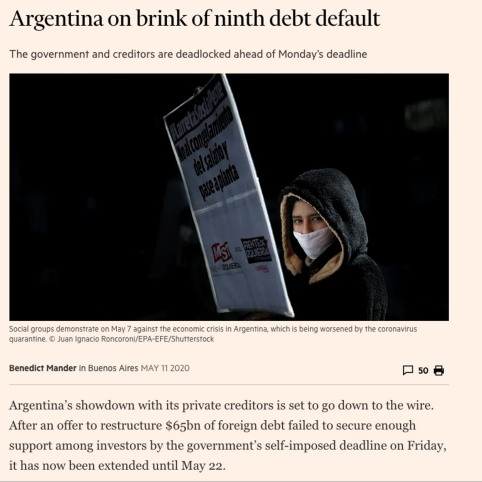
Argentina’s current sovereign credit rating is Ca. The current central bank rate of Argentina is 70%. Assume that you want to invest in Buenos Aires Stock Exchange-listed companies. What is the appropriate risk-free rate that you would use?
Refer to the website below for more information:
http://pages.stern.nyu.edu/~adamodar/New_Home_Page/datafile/ctryprem.html
Discussion Question 3: Equity Risk Premium and Cost of Equity
Woolworths’ current equity risk premium is 5.00%. Coles has a current beta of 0.73 (Morningstar). The current risk-free rate in Australia is 4.50%. What is Coles’ cost of equity? Can we calculate it given this information?
Discussion Question 4: Beta
The Table below shows an extract from the five-year daily price chart of Freehill Mining Ltd (ASX: FHS):
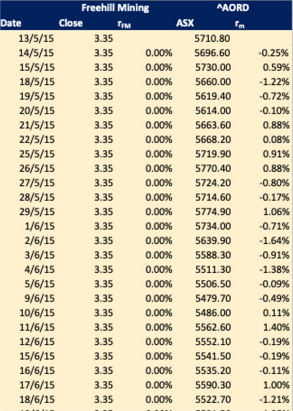
Mr Amateur Investor has estimated the market model based on this data to calculate the CAPM cost of equity. The Table below shows the results:

How reliable is this beta?
Notes: rFM is the daily return of Freehill Mining and rm is the daily market return.
Discussion Question 5: beta
ABC Ltd is listed on the Imaginary Stock Exchange (ISE). The pie chart below shows the relative market capitalisations of the stocks listed on the ISE. Assume that the market capitalisations are stable.
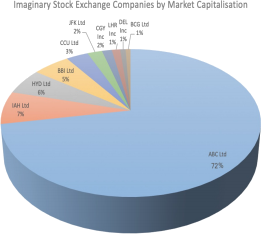
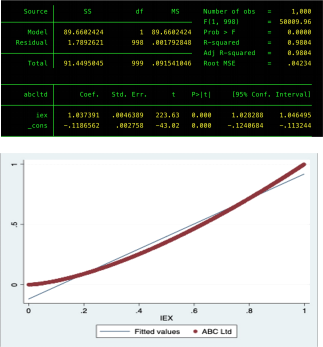
What does the estimated beta of 1.037 tell you about the relative risk of ABC Ltd?
The following Table and chart show the results of the estimation of the CAPM for ABC Ltd using daily returns of the last 5 years. ABC Ltd is a highly liquid stock.
Discussion Question 6: Implied Cost of Equity
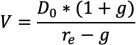
The share price of Walmart Inc closed at US$52.55 on December 29, 2023. It paid dividends per share of US$2.28 in 2023. Walmart has been increasing dividends by approximately 2% annually for the past several years. Assume that this dividend growth will continue indefinitely. Based on this information calculate Walmart’s implied cost of equity (ICE). With the ICE that you have calculated, estimate the value of Walmart’s equity.
Use Gordon’s dividend growth model to calculate firm value. Comment on the usefulness of ICE as a measure of cost of equity.
Discussion Question 7: WACC
The current share price of Hello Ltd is $32.00. The company has 1.5 million shares outstanding. It has outstanding debt with a value of $25 million on its balance sheet. The company reported EBIT of $12.89 million, EBT of $11.52 million and Net Income of $7.69 million on its last income statement. Assume that the equity risk premium is 5 percent and that Hello Ltd has a beta of 0.65. Using this information, calculate the weighted average cost of capital (WACC) of Hello Ltd. Assume that the risk-free rate is 3 percent.
Required:
i) What is the best estimate of the pre-tax cost of debt given the above information?
ii) What is the best estimate of the corporate tax rate given the above information?
iii) Use the CAPM to calculate the cost of equity for Hello Ltd.
iv) What is the (after tax) weighted average cost of capital (WACC) for Hello Ltd?