Hello, if you have any need, please feel free to consult us, this is my wechat: wx91due
SYSEN 5220 System Dynamics
Assignment 5
Stocks and Flows
1. Identifying Stocks and Flows.
This exercise is taken from Martin (1977) Beginning Modeling Exercises, a document published under the System Dynamics in Education Project at the Massachusetts Institute of Technology.
Below are fourteen rows of variables. For each row, identify which variable is a stock and which are the flows that change the stock. Draw a box around the stock. The first row has already been done as an example. The population of skunks is a stock. The size of the skunk population changes with a number of births each year and a number of deaths each year. Draw a stock and flow diagram to indicate the stock and whether the other variables are inflows to, or outflows from, the stock for each of the rows of variables. Label the units for each variable too.
|
Births |
Deaths |
Skunk population |
|
dumping |
plastics in landfills |
|
|
harvesting |
fir trees |
planting |
|
brownies in stomach |
eating |
digesting |
|
consumption |
energy resources |
|
|
completing |
assigning |
homework |
|
returning |
borrowing |
library books checked out |
|
velocity |
distance |
|
|
velocity |
acceleration |
|
|
sand castles |
demolishing |
constructing |
|
shrinking |
Pinocchio’s nose |
lengthening |
|
cavities |
developing |
filling |
|
expenses |
income |
money in bank account |
|
Building |
Nuclear weapons |
disarming |
2. Adding Stock and Flow Structure to Causal Diagrams
Consider the conceptualization case studies (workload management) presented in chapter 5. Redraw the diagram showing the important stock and flow structure along with the feedback structure shown in the diagram. In particular, identify the main stocks and flows. Consider whether the explicit representation of the main stocks and flows enhances your ability to understand the dynamics of the system or merely clutters the diagram.
3. Modifying Stock and Flow Maps
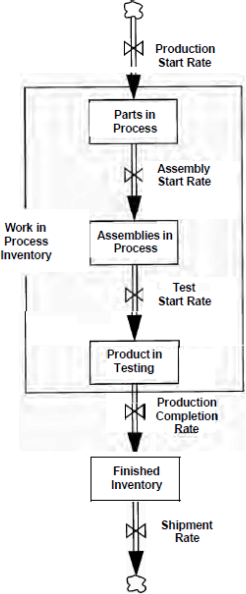
a. Modify the following diagram to represent the case where units that fail testing are scrapped.
b. Modify your diagram to represent the case where items failing testing are returned to assembly for rework.
4. Linking Stock and Flow Structure with Feedback
Often understanding the dynamics of a system requires linking the feedback loop structure with the stock and flow structure. As an example, consider the gasoline shortages of the 1970s. In 1979 the United States (and some other industrialized nations) experienced a severe gasoline shortage. Iran’s exports of oil dropped in the wake of the revolution there, and petroleum prices on the world market increased sharply. Within weeks, a shortage of gasoline began. Some service stations found their tanks emptied before the next delivery. Drivers, remembering the first oil embargo in 1973 and worried that they wouldn’t be able to get gas, began to top off their tanks, instead of filling up only when the gas gauge fell toward empty. Soon, long lines of cars were seen idling in front of gas stations, and “Sorry-No Gas” signs sprouted along the highways of America as station after station found its underground tanks pumped dry. The shortage was the top story on the evening news-aerial footage of cars lined up around the block, close-ups of “No Gas” signs, and interviews with anxious drivers dominated the news. In some states, mandatory rationing was imposed, including limiting purchases to, for example, no more than $10 worth of gas. California imposed odd/even purchase rules: Drivers were allowed to buy gas only every other day, based on whether their license plate number was odd or even. It seemed that the supply of gasoline had been slashed.
Curiously, the impact of the Iranian revolution on the flow of oil to the US was small. True, US oil imports from the Persian Gulf (including Iran) fell by 500,000 barrels per day between 1978 and 1979, about 3% of US consumption, but imports from other nations increased by 640,000 barrels per day, so imports in 1979 actually increased by 140,000 barrels per day. Domestic production fell by 150,000 barrels per day, so total supply was essentially constant, while consumption fell by about 330,000 barrels per day, a drop of 2% from 1978. Plainly, for the year as a whole, there was no shortage. But if the flow of oil into the US was essentially constant, what caused the shortage? Where did the gas go?
First, develop a stock and flow map for the gasoline distribution system. You need not consider the entire supply chain for gasoline but can focus on retail distribution. Your diagram should begin with the flow of gasoline to service stations, then represent the stock and flow structure for its subsequent storage, sale, and eventual combustion.
Once you’ve mapped the stock and flow structure, identify the information inputs to the rates of flow in your diagram. Assume that the rate at which gasoline is delivered to service stations is exogenous. By identifying the information inputs to the flows in your stock and flow map, you will be closing some feedback loops, loops which should help explain why the shortage occurred and answer the question, Where did the gas go? Be sure to ask how individual drivers would learn about the shortage and what their behavior would then be.
Finally, using your diagram, assess the likely effectiveness of the maximum purchase and odd/even policies. Do policies of this type help ease the shortage or make it worse? Why? What policy would you recommend to ease the shortage? Explain why your policy would be effective in terms of the stock/flow and feedback structure of the system.