Hello, if you have any need, please feel free to consult us, this is my wechat: wx91due
MATH2022: Linear and Abstract Algebra
Semester 1, 2025
Assignment 2
1. Using the definition, carefully show that each of the following are subspaces of the given vector space.
(a) W = {(a1, a2, . . . , an) ∈ Fn : a1 + a2 + · · · + an = 0} ⊆ Fn
(b) Z = {f ∈ RR : f(a) = 0 for a fixed number a ∈ R} ⊆ RR
(c) For L : Fn → Fm a linear map, the set
Im(L) := { ∈ Fm : there exists some
  ∈ Fn such that = L()} ⊆ Fm
2. Give a proof for the following (unrelated!) statements about linear dependence and independence.
(a) Let V be a vector space over a field F, and let  be a collection of vectors. Suppose that Y ⊂ X is a nonempty subcollection of these vectors, and we know that Y is a linearly dependent in V . Show that the collection X is necessarily linearly dependent.
(b) Let V be a vector space over a field F, and let  be a basis for V . Let ∈ V be a nonzero vector, and suppose it has coordinate vector

with µ1 ≠ 0. Prove that the set

is also a basis of V .
Remark: There is nothing special about µ1 here! What we’re really saying is that there is at least one of the basis vectors  in B that we can swap out for a nonzero vector
  and still get a basis! I’ve just phrased it as above for clarity.
3. Let P2(R) be the vector space of all two-variable polynomials with real coefficients, in the variables x and y. For example, we have elements like 
(a) We define two maps 
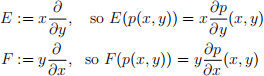
where  and
and  are the partial derivatives with respect to the variables x and y, respectively. Show that E and F are both linear maps.
Note: If you are not quite familiar with partial derivatives, fear not! They behave much like regular derivatives. Check out the many resources online or from friends about how partial derivatives work. The key idea is that  “treats y like a constant,” and similarly for
  . So for example, if p(x, y) = x4 − 3x2y3 + 2y − 7, then taking the derivative of the x-variables and pretending y is a constant, we get
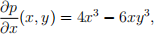
and similarly treating y like a variable and x like a constant, we get
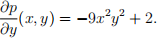
(b) Let  be the subspace of two variable polynomials of total degree three; that is, is the subspace spanned by the basis

Show that in fact both E and F map P 2 3 (R) → P 2 3 (R). Do this by showing that E and F send each of the basis elements to elements in .
(c) For a vector space V and a linear map T : V → V , we say that a vector ∈ V is an eigenvector of T if T() = λ for some scalar λ.
Define the linear map H : → as the difference of the compositions
H := E ◦ F − F ◦ E.
Show that the given basis of are all eigenvectors of H, and find their eigen-values.