Hello, if you have any need, please feel free to consult us, this is my wechat: wx91due
1. Introduction to Time Series
ECO374H1
Department of Economics
Summer 2025
Forecaster's Objective
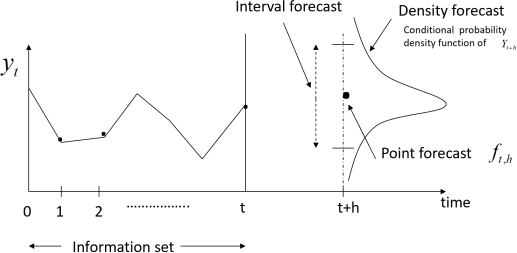
For illustration, see the code file 1. ACF and PACF (section 1)
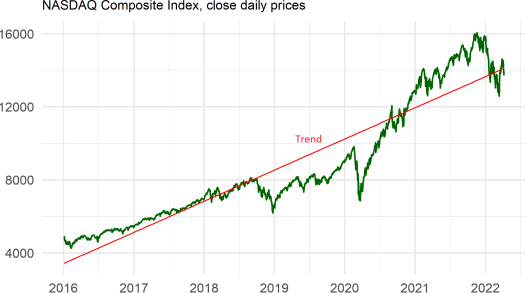
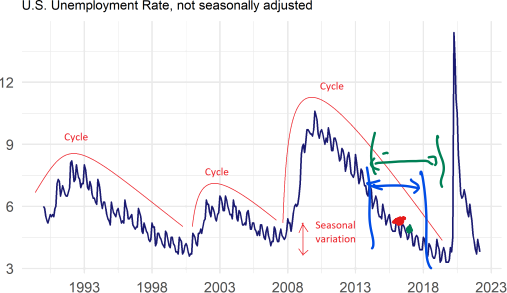
Features of Time Series
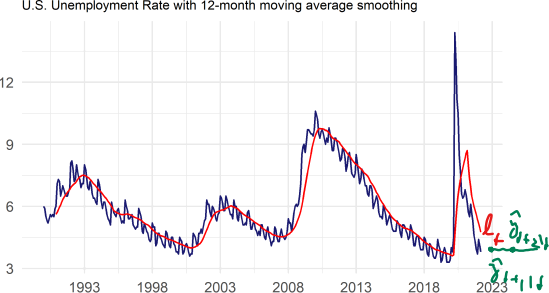
Moving Average Smoothing
Moving Average Smoothing (MAS) of order m:
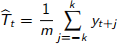
where m = 2k + 1
Note that each data point has the same weight m/1
MAS is typically used for "seasonal adjustment" of data, i.e. filtering out seasonal variation to estimate the trend-cycle component
Simple Exponential Smoothing
Simple Exponential Smoothing (SES) assigns the most recent observation the most weight, and the most distant (in time) observation the least weight
Denote by  the trend-cycle component of {yt} at time t
At time t we observe yt and can update our estimate of and predict yt+1:
 =
=  yt + (1 - )-1
yt+1|t =
assuming we know - 1
We can estimate e0 using an MAS of e.g. the first 10% of the data and then obtain subsequent recursively from the Smoothing equation
α is a smoothing constant such that 0 < α < 1
Smoothing Parameter in SES
For a data set  the optimal level of α can be determined by minimizing the sum of squared "in-sample" errors of one-period-ahead forecasts
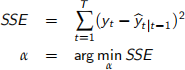
The minimization is performed numerically
SES Forecasts
SES has a "áat" forecast function

SES forecasts have limited use beyond very short time horizon forecasts (similarly for MA smoothing)
Nonetheless, SES weight distribution provides the backbone of many dynamic forecasting models that we will cover