Hello, if you have any need, please feel free to consult us, this is my wechat: wx91due
Department of Electrical & Computer Engineering
EECE2310 – Introduction to Digital Design and Computer Architecture
Homework 4
Submission Instructions
- Homework assignments must be done by each student individually (no groups are allowed).
- For the programming problems (RISC-V assembly):
1. Your code must be well commented by explaining what the lines of your program do. Have at least one comment for every 4 lines of code.
2. At the beginning of your source code files (only if a separate source code file is required by the problem) write your full name, and NU student ID.
3. If required by the problem, test your code using the RARS assembler.
- For all problems, include explanation of all steps of your answers/calculations not only the final results and if the problem requires “implementation”, then a circuit/block diagrams must be provided, unless it is mentioned otherwise in the problem statement.
- Submit the following to the homework assignment page on Canvas:
1. Your homework report developed by a word processor (e.g., Microsoft Word) and submitted as one PDF file. Any handwritten answers will not be accepted. For answers that require drawing of diagrams and if it is difficult on you to use a drawing application (e.g., circuitlab.com), you can neatly hand draw “only” these diagrams, scan them, and insert the scanned images in your report document. The report includes the following (depending on the assignment contents):
a. Answers to the non-programming problems that show all the details of the steps you follow to reach these answers.
b. A summary of your approach to solving the programming problems.
c. The screen shots of the sample runs of your programs.
2. If required by any of the questions, your well-commented programs source code files (i.e., the .asm files).
Do NOT submit any files (e.g., the PDF report file and the source code files) as a compressed (zipped) package. Rather, upload each file individually.
Note: You can submit multiple attempts for this homework, however, only what you submit in the last
attempt will be graded (i.e., all required reports and files must be included in this last attempt).
Q1 (25 Points)
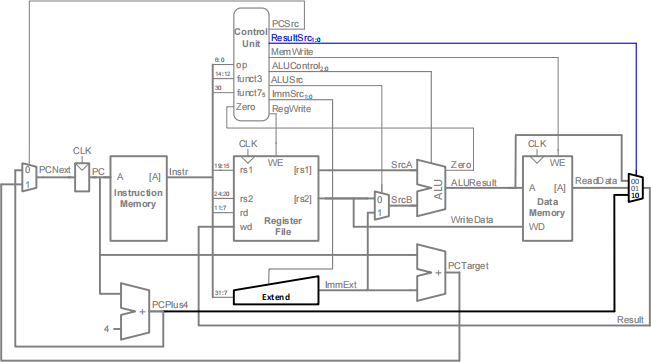
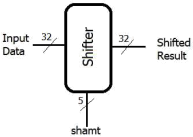
Extend the above single-cycle datapath and control block diagram by adding the shifter shown below to implement the slli instruction. This shifter must be added to the datapath as a separate circuit from the ALU. You also must add a new control signal named Shift. The slli instruction has the following format (which is similar to the I-type format) slli rd,rs1,imm

The instruction shifts the value in the rs1 left number of bits equal to the 5-bit value stored in the imm field and stores that value in register rd. The figure shows the shifter to be used.
a) Draw the extended block diagram to include the new proposed control signal, the shifter circuit, and any needed additional
circuits. Make sure to label any added line following the same labeling technique shown in the above block diagram.
b) Extend the “Control Unit - Instruction Decoder” table in the
lecture slides to reflect the support for the new slli instruction. Add to the table a new row for the slli instruction and a new column for the new Shift signal.
Q2 (25 Points)
Assume the elements in the RISC-V single-cycle datapath and control have the following delays in picoseconds (ignore the delay time through the Control Unit).
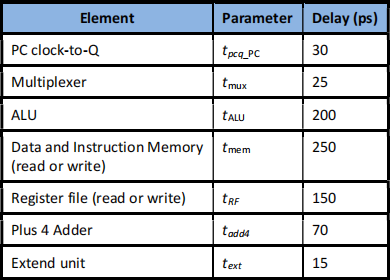
For each of the following two instructions, calculate the total time in ps needed from the moment the clock edge triggers the PC to read the instruction address until the data (and, if needed, its destination address) is ready to be written to its destination (register file or data memory) right before the next clock edge. Show all the steps of your calculations.
Note: This is not the Tc as in the lecture and hence no need to consider the setup time of the register file or the data memory.
a) add t1, t2, t3
b) sw t0, 32(s3)
Q3. (25 Points)
For a system that uses the little-endian data byte ordering and right after executing the following RISC-V instructions, what will be the 32-bit contents of registers t1, t2, t3, t4, t5 (in hexadecimal)? You must show all the steps you used to get your answer and explain your results on a layout that shows the data memory contents. Start the data segment at address zero and apply automatic alignment on its contents.
.data
AH: .half 0x1234, 0x8899, 0x5555
AW: .word 0x66667777, 0x00ABCDEF
.text
main:
la t0, AH
lw t1, 0(t0)
lb t2, 1(t0)
lb t3, 2(t0)
lbu t4, 3(t0)
lw t5, 8(t0)
...
Q4 (25 Points)
Write a RISC-V program that asks the user to input string. The program then removes all space characters from the string. The program finally displays the resulting string without spaces. The following C code shows the proposed algorithm for the program. The string is traversed with two indices, called old_index and new_index, where the latter always takes a value less or equal to the former. When a non-space character is found, the character at position old_index is copied to position new_index, and both indices are incremented. When a space is found, the current character is not copied, and only old_index is incremented. The algorithm stops when a null character is found.
#include
int main() {
// Read string
char s[100];
printf("Enter string: ");
gets(s);
// Remove spaces
char c;
int old_index = 0;
int new_index = 0;
do {
// Read character
c = s[old_index];
// Old position moves ahead
old_index++;
// If it's a space, ignore
if (c == ' ') continue;
// Copy character
s[new_index] = c;
// New position moves ahead
new_index++;
} while (c);
// Print result
printf("New string: %s\n", s);
}
a) Write the full well-commented RISC-V program and submit it in a file named nospace.asm
b) Run your program on RARS and include in your homework report screen shots of the program sample runs. Make sure to enter a string containing spaces to demonstrate the correct functionality of the algorithm.