MAT 223 - ASSIGNMENT # 5
Instructions
Please submit solutions to all the questions listed below on Crowdmark. Your assignment is due before 11.59pm on November 12. You should have received an email from Crowdmark containing the assignment questions and a link you can use to submit your solutions. You will need to submit a separate file for each question, so it is easiest to write up your solution to each question on its own paper. Please see the “Crowdmark How-To” document on the course page for tips about simplifying the submission process.
You can find a rubric for how we grade HW on the course page. (It was also send out with the CM version of the assignment.)
Your solutions should be neat and legible (preferably in black or blue ink). The written assignment is worth 6 points, and we will grade three (3) questions.
Technical issues will not be accepted as a reason for failing to submit on time, so please leave yourself ample time to submit your HW before the deadline.
Assigned Questions
(1) Find the equation of the plane containing the points (1, 2, 3),(2, 2, 3),(−1, −1, −1).
(2) Consider the transformation T : R3 → R2 given by T 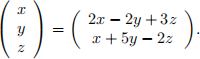
(a) Verify that T is linear using the definition.
(b) Find a matrix A, so that T = TA.
(3) Does the linear transformation T : R3 → R3 given by T 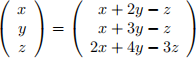 have an inverse? If so, explain why, find it, and express your final answer as an explicit equation for T−1
(similar to the one given for T). If not, explain why.
have an inverse? If so, explain why, find it, and express your final answer as an explicit equation for T−1
(similar to the one given for T). If not, explain why.
(4) Let R : R2 → R2 be rotation by 4π/3 counter-clockwise around the origin, and T : R2 → R2 be reflection across the line y = 2x. Consider the transformation given by U = R ◦ T ◦ R.
(a) Find the matrix for U.
(b) Sketch a visualization of U, showing the unit square on one set of axes and its image under the transformation U on a separate set of axes.
(c) Find the area of the parallelogram spanned by U(e1), U(e2).
(5) In this question we introduce a new definition:
Definition: We say that a linear transformation T : Rn → Rn is right-handed if det AT > 0, and we say that it is left-handed if det AT < 0. (Recall: Every linear transformation T has a matrix AT .)
(a) Show that if T is left-handed, then T is invertible.
(b) Show that if T is left-handed, then T−1 is left-handed.
(c) Let T be left-handed. For which k ∈ Z is Tk right-handed? Justify your answer. (Note, for k < 0, Tk is the corresponding power of T−1 . E.g. T−3 = (T−1)3.)
(d) True/False: If S, T : Rn → Rn are both left-handed, then S ◦ T is also left-handed. (Justify your answer.)
(6) Determine if each of the following statements is true or false. If it’s true, explain why. If it’s false explain why not, or simply give an example demonstrating why it’s false. (A correct choice of “T/F” with no explanation will not receive any credit.)
(a) The parallelepiped spanned by 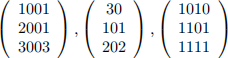 has the same volume as the parallelepiped spanned by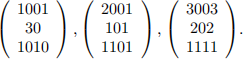
(Hint: You don’t want to actually calculate the volume, but have a look at how you’d compute each volume and then compare the two.)
(b) Let T, S : R n → R n be linear. If S ◦ T is invertible, then both S, T are invertible.
(c) Suppose that A, B are matrices so that AB is defined, and size has n × n. If the linear transformation TAB : R n → R n is invertible, then both A, B must be n × n invertible matrices.