Hello, if you have any need, please feel free to consult us, this is my wechat: wx91due
Take-Home Assignment 5
MAT223 - Winter 2025
1 Read the following definitions carefully, and then answer the questions below.
Definition Given a subspace U of Rn , and a non-zero v ∈ Rn we define the following new subset S of Rn :
S = U + {v} = {x + v | x ∈ U}
We say that S is a shift of U (or that S is the shift of U by v).
The dimension of a shift of a subspace U is the dimension of U itself.
1.1 True or False: If A is an 3 × 3 matrix, and b ∈ R3 is non-zero, then the set of solutions to Ax = b is a shift of null(A).
1.2 Find an infinite subset X of R3 which is not a subspace, but is also not the shift of any subspace of R3 . Justify your answer by showing that X is not a subspace, and that it could not be the shift of any subspace.
1.3 Show that if U is a subspace of Rn , v ∈ Rn is non-zero, and p, q are distinct elements of S = U + {v}, then for any real number t ∈ R, (1 − t)p + tq is in S. (Intuitively, this is showing that every point on the line containing p and q is in the set S.) Hint: consider the simpler version of this where you ignore v and consider only U itself first and prove the analogous statement.
2 Let {b1, ..., bk} be an orthogonal basis for a subspace U of Rn . Show that the transformation T : Rn → Rn given by T(x) = projU (x) is a linear transformation.
3 Let 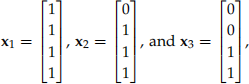 let U = span{x1, x2, x3} and define A to be the matrix with columns x1, x2, x3.
3.1 This will not be marked - do not submit on Crowdmark. Verify that the set {f1,f2,f3} of U, where 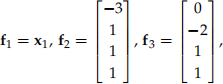 is an orthogonal basis for U. To do this, apply the Gram-Schmidt algorithm to the set {x1, x2, x3}, scaling the resulting vectors as needed.
3.2 This will not be marked - do not submit on Crowdmark. Normalize the vectors in the previous part, to get an orthonormal set of vectors
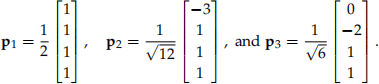
3.3 Let P be the matrix with columns p1, p2, p3. Explain why im(A) = im(P).
3.4 Let B = [bij] (i.e. it has entries bij) be given by B = P TA. Show that x1 = b11p1, x2 = b12p1 + b22p2 and x3 = b13p1 + b23p2 + b33p3. (Notice that B is invertible and upper-triangular.)
3.5 Verify that PPT = I, and use this to conclude that A = PB.
Note: this shows that A can be written as the product of a matrix P with nice (orthonormal) columns with the same image, and a nice upper triangular matrix B!
4 This will not be marked - do not submit on Crowdmark. Let A be an m × n matrix, and let x ∈ Rn . Show that there must be r ∈ col(A T) and n ∈ null(A) so that x = r + n.