Hello, if you have any need, please feel free to consult us, this is my wechat: wx91due
PRACTICE QUESTIONS
FINA 501 INTRODUCTION TO FINANCE
QUESTION 1: Time Value of Money (10 marks)
a. To buy his favourite car, Larry is planning to accumulate money by investing his end- of-year bonuses for the next five years in a security which pays a 10 percent annual rate of return. The car will cost $40,000 at the end of the fifth year and Larry's bonus is $6,000 a year. Will Larry accumulate enough money to buy the car? (6 marks)
b. You have been given the opportunity to earn $20,000 five years from now if you invest $9,524 today. What will be the rate of return to your investment? (4 marks)
QUESTION 2: Portfolio and Rates of Return (2 marks)
You bought a share for $25.80. After 1 year, you sold the share for $27.5. The share paid a $1.40 dividend per share.
a. What was your total dollar return? Show all work and formula(s) clearly. Round only the final answer to two decimal places, where applicable. (1 mark)
b. What was your total percentage return? Show all work and formula(s) clearly. Round only the final answer to two decimal places, where applicable. (1 mark)
QUESTION 3: Portfolio and Rates of Return (2 marks)
You own a share portfolio invested 10% in shares ofA, 30% in shares in B, 35% in shares in C and 25% in shares in D. The betas for these four shares are 0.8, 0.9, 1.2 and 1.4, respectively. What is the portfolio beta? Show all work and formula(s) clearly. Round only the final answer to two decimal places, where applicable.
QUESTION 4: Portfolio and Rates of Return (3 marks)
You have $100,000 to invest in a portfolio that has two companies’ shares: Share A and Share Z. Share A has a beta of 1.30 and an expected return of 18.60%, while Share Z has a beta of 0.80 and an expected return of 12.60%. You target to have a portfolio beta of 1.10.
a. How much (in percentage and dollar amount) will you invest in each share? (2 marks)
b. What is the expected rate of return of your portfolio? (1 mark)
QUESTION 5: Bonds (3 marks)
A.I. Company will issue a zero-coupon bond this coming month. The projected yield for the bond is 6%. The par value of the bond is $1,000. Clearly show formula number or Excel formula, relevant values and final answer. Round final answer to two decimal places.
a. What is the amount of coupon payment? Briefly comment on your answer. (1.5 marks)
b. What is the price of the bond using a semi-annual convention if the maturity is 30 years? (1.5 marks)
QUESTION 6: Bonds (4 marks)
Mid-Growth Company is about to issue a bond with semi-annual coupon payments, a coupon rate of 5.5%, and par value of $1,000. The yield-to-maturity for this bond is 7.5%. Clearly show formula number or Excel formula, relevant values and final answer.
a. What is the price of the bond if the bond matures in five years? (1.5 marks)
b. What is the price of the bond if the bond matures in twenty years? (1.5 marks)
c. Based on your calculations in parts (a) and (b) above, what do you notice about the price of the bond in relationship to the maturity of the bond? (1 mark)
QUESTION 7: Bills (2 marks)
All Tracks Investments Ltd is buying a 90-day bank bill today. The bill matures in 90 days’ time. The bill has a face value of $100,000 and the current market yield on this bill is 2.55% pa. What is the price that the company will have to pay to buy the bill today? [Show all steps, workings, and formula(s) clearly. Round final answer to two decimal places, where applicable.]
QUESTION 8: Stocks (4 marks)
New Chapter Inc. does not expect to initiate dividends for 15 years. At the end of Year 15, the company will start to pay dividends and expects its dividends to grow at 4.5% forever. The company has an 10.5% required rate of return.
a. What is an estimate of the company’s stock price at the beginning of the 15th year (the end of 14th year) if its dividend at the end of year 15 is $2.5? [Round your answer to two decimal places.] (2 marks)
b. What is the company’s stock price in today's dollars if the desired rate of return is 10.5%? [Hint: use 14 years for the number of periods.] (2 marks)
QUESTION 9: Stocks (2 marks)
Low Carbon Ltd has preferred stock with a par value of $50 and an annual $2.5 cumulative dividend. An investor is willing to pay $15 for this preferred stock. What yield or rate of return is this investor seeking for the investment? Clearly show formula number or Excel formula, relevant values and final answer.
QUESTION 10: Stocks (4 marks)
A company is expected to pay the following dividends over the next four years. From year five onwards, the company is committed to maintaining a constant dividend growth rate of 5% forever. The required rate of return on company’s shares is 10.5%. What is the company’s current share price? Clearly show formula number or Excel formula, relevant values and final answer. Round only the final answer to two decimal places, where applicable.
|
Year |
Dividend ($) |
|
1 |
7 |
|
2 |
9.5 |
|
3 |
12.5 |
|
4 |
3.25 |
QUESTION 11: CAPM (4 marks)
Suppose the risk-free rate is 2.5%, the expected market return is 12.5%, and New Born’s share has a beta of 0.8.
a. Based on the CAPM, what is the expected return on this share? Clearly show formula number or Excel formula, relevant values and final answer. (2 marks)
b. Compare the beta and expected return of this share with the market beta and expected market return. Relate these figures with the concept of risk and expected return. [Note: The discussion must be in your own words. Word limit: 60 words, excluding figures; answers beyond word limit will not be marked.] (2 marks)
QUESTION 12: Theory/Discussion: Diversification (5 marks)
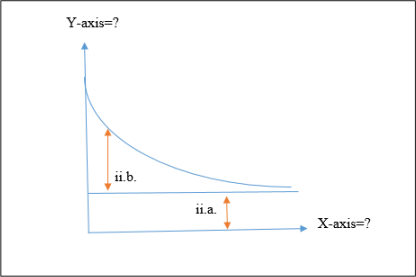
In this course, you have learned about the concept of risk and diversification. In your own words, explain what the following diagram would mean in terms of diversification. Your discussion should include (i) what X-axis and Y-axis in the diagram measure; (ii) identify and briefly explain the two major risk components measured by ii.a. and ii.b. in the diagram; (iii) identify the portion of risk that cannot be diversified away and briefly explain why; and (iv) the overall message portrayed in this diagram in terms of diversification. [Word limit: 150 words (answers beyond word limit will not be marked).]
QUESTION 13: Dividends and stock investments (5 marks)
In this course, you have learned that not all public companies would pay dividends. Clearly answer the following questions.
a. Some companies choose to pay dividends. Clearly list and explain one or more reasons for paying dividends. [Word limit: 50 words. Answers beyond the word limit will not be marked. Answers must be written in your own words.] (1 mark)
b. Certain companies choose not to pay dividends. Clearly list and explain two or more reasons for not paying dividends. [Word limit: 50 words. Answers beyond the word limit will not be marked. Answers must be written in your own words.] (2 marks)
c. Explain why some investors would prefer dividend-paying stocks and why some investors would invest in non-dividend paying stocks. [Word limit: 50 words. Answers beyond the word limit will not be marked. Answers must be written in your own words.] (2 marks)