Hello, dear friend, you can consult us at any time if you have any questions, add WeChat: daixieit
Algorithm Design
Assignment 4
s1 2025
This assignment is due on May 21 and should be submitted on Gradescope. All submitted work must be done individually without consulting someone else’s solutions in accordance with the University’s “Academic Integrity” policies.
As a first step go to the last page and read the section: “Advice on how to do the assignment.”
Problem 1. (50 points)
As an algorithm theorist working for database technology startup QDijkstra, you have recently been working on determining the tractability of GQL queries which search for paths optimizing over multiple metrics. One such query might ask for a route from Bathurst to Sydney with total transit time at most some value T, which is also highly scenic, which we model as having a combined "scenery score" at least as high as some value S.
MATCH (u:City WHERE u.name="Bathurst")
-[r]->*
(v:City WHERE v.name="Sydney")
WHERE SUM(r.travelTime)<=T
AND SUM(r.sceneryScore)>=S
You have reformulated the task of evaluating this query as an algorithm de-sign problem, which you refer to as the Scenic-Route problem: formally, given an undirected simple connected graph G = (V, E), two vertices u, v ∈ V, a travel time function t : E → Z>0, a scenery score function s : E → Z>0, a positive integer target time T, and a positive integer target scenery score S, determine whether there exists a vertex path p = p1, p2, . . . , pk through G from u to v, such that
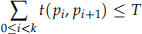
and
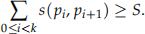
In Assignment 2 problem 2, it was established that the Scenic-Route problem can be solved in O((n + m)T) time. Being well-versed in algorithm theory, the value T appearing in this time bound bugs you: as T can be arbitrarily large, the value T appearing in the time bound means that your algorithm has pseudopolynomial time complexity. A natural pessimist, you suspect that this pseudopolynomiality is likely to be inherent to the Scenic-Route problem, and thereby to the original query. To provide evidence of this claim, you set out to establish that the Scenic-Route problem is NP-complete.
a) Prove that the Scenic-Route problem is in NP. [20 points]
b) Prove that the Scenic-Route problem is NP-complete. [30 points]
Problem 2. (50 points)
As CEO of Naboo starship manufacturing company Theed Hangars, you have spent the last few weeks scrambling between star systems to strike deals across the Galactic Republic’s Free Trade Zone for relief from impending tariffs on inter-system trade, which threaten to devastate the N-1 starfighter supply chain. Unfor-tunately, it is becoming increasingly evident that you may not be able to keep the entire N-1 supply chain intact in the face of these new tariff schedules, even with the quota allowance deals which you have been able to strike.
Having spoken to RNSF officials about the matter, they have agreed to vary their order of record for the year, and thereby accept as many N-1 starfighters as your company produces for the year, if it will enable you to put in place a supply chain schedule which keeps as many factories open as possible. While this may help, the problem of arriving at a supply chain schedule which keeps as many factories open as possible may yet prove to be tricky.
Formally, an instance of the N1-Supply-Chain problem consists of the following:
• A set of star systems numbered from 1 to m.
• For each pair of star systems i, j, and each T ∈ {frame, engines}, you are given a maximum allowable inter-system quota, a non-negative integer qijT in-dicating the maximum amount of goods of type T which are allowed to be imported from system i to system j.
• A set of n factories. For each factory i, you are given...
– Its type, Ti ∈ {frame, engines, fitout}.
– Its location, a star system Li ∈ {1, . . . , m}.
– Its required output to remain profitable, a non-negative integer ai
– Its maximum manufacturing capacity, a non-negative integer bi .
A supply chain schedule is an assignment of any amount of spaceframes to frame, engines, and fitout factories, such that
1. For any two distinct systems i and j, the amount of spaceframes passing from factories of type frame in system i to factories of type engines in system j is at most qijframe.
2. For any two distinct systems i and j, the amount of spaceframes passing from factories of type engines in system i to factories of type fitout in system j is at most qijengines.
3. The amount of spaceframes assigned to any factory i is at most bi .
4. The amount of spaceframes assigned to any factory i is either zero (in which case factory i is considered closed), or at least ai (in which case factory i is considered open).
The goal of the N1-Supply-Chain problem is to determine a supply chain sched-ule such that that as many factories as possible remain open.
a) Define the decision version of the N1-Supply-Chain problem. [5 points]
b) Prove that the decision version of the N1-Supply-Chain problem is in NP. [15 points]
c) Prove that the decision version of the N1-Supply-Chain problem is NP-complete. [30 points]
Note that you may use, without further justification, the fact that Assignment 3 problem 1 has a polynomial-time solution.
Advice on how to do the assignment
• Assignments should be typed and submitted as pdf (no pdf containing text as images, no handwriting).
• Start by typing your student ID at the top of the first page of your submission. Do not type your name.
• Submit only your answers to the questions. Do not copy the questions.
• You may use paragraphs, lists or itemized points, pseudocode, or any combi-nation of the above to organize your algorithm description. Do not include actual code in your submission. (Penalties will apply!)
• When designing an algorithm or data structure, it might help you (and us) if you give a brief (1-2 sentence) description of the overall idea, and after that develop and elaborate on details. If your algorithm is stated in pseudocode or the details of the algorithm are complex, then a brief description of the overall idea is required. Remember that an assignment in this course is an exercise in effectively presenting and communicating technical ideas (i.e. not just "solving the problem"), and will be graded accordingly.
• Refrain from explaining "why" your algorithm does what it does in the algo-rithm description itself. The "why" belongs in your proof. Your algorithm description should be a lean, complete, and unambiguous statement of just "what" your algorithm is.
• If you use pseudocode in your algorithm description, avoid adhering to any particular pseudocode "standard". Each line should endeavour to be "prosaic" in describing the intended step, with mathematical notation interspersed to denote any objects or concepts which you feel cannot be conveyed clearly in prose. Treat the pseudocode in Kleinberg and Tardos as exemplary.
• In general, try to be prosaic rather than syntactic when describing your algo-rithm. Treat this as an advantage! You do not need to describe your algorithm to a compiler or interpreter, so you can focus on phrasing your description for ease of readability by a human reader.
• Be careful with giving multiple or alternative answers. If you give multiple answers, then we will give you marks only for "your worst answer", as this indicates how well you understood the question.
• You can use the material presented in the lectures or textbooks without prov-ing it. You do not need to write more than necessary (see comment above).
• Unless otherwise stated, we always ask about worst-case analysis, worst-case running times, etc.
• If you use further resources (books, scientific papers, the internet,...) to for-mulate your answers, then add references to your sources and explain it in your own words. Only citing a source doesn’t show your understanding and will thus get you very few (if any) marks. Copying from any source without reference is considered plagiarism.